
Emergency Air Duct Cleaning Near Me: What Carlsbad Homeowners Should Do First
If you suspect contaminated air is moving through your ductwork right now, shut the HVAC system off at the thermostat, then at the breaker. That single step stops the blower fan from pulling whatever is in the ducts, whether it’s rodent waste, smoke residue, or sewage moisture, into every room of the house. The next call should be to a company that can confirm HEPA extraction equipment is available today, not next week. If you’d rather skip the research and talk it through, call (855) 353-1322. We answer 24/7.
Most “emergency duct cleaning” searches happen after something has already gone wrong. A rat died in the duct run above the garage. A sewage line backed up into the air handler closet. A kitchen fire sent smoke through the return vents. The instinct is to grab a phone and start searching “emergency air duct cleaning near me.” The problem is that in those first thirty minutes, the HVAC system is often still running, and the blower fan is doing exactly what it was designed to do: distribute air. If that air is contaminated, the house gets contaminated with it.
Here is what we tell homeowners in Carlsbad to do before they make a single phone call.
The First Response Checklist: What to Do Before You Call
Emergency response for duct contamination is less about cleaning and more about containment. You want to stop the spread first, then bring in the right equipment. There is a specific order to this, and skipping steps makes the eventual cleanup larger and more expensive.
Here is the sequence we recommend:
- Shut the system off at the thermostat. Switch it from cool or heat to off. Do not just raise the temperature setting, because the fan can still run independently on many systems.
- Flip the HVAC breaker. This is the step most people skip. The thermostat off setting prevents normal cycling, but flipping the breaker guarantees no fan operation while you assess the situation.
- Close the supply registers in the rooms you believe are affected. Closing registers creates a partial barrier. It is not airtight, but it reduces the volume of air moving through those duct branches.
- Do not run the fan “on” to dry anything out or blow it clear. This is the most common mistake that makes a bad situation worse. The fan spreads particulates, it does not remove them.
- If you can access the return grille, hold a flashlight to it and look. You are checking for visible staining, debris, or moisture. Do not reach inside. If you see mold or sewage residue, leave the area and call a professional.
- Take photos before anything is touched. Insurance claims go much smoother when the adjuster can see the original condition of the contamination, not the post-cleanup version.
The goal in the first hour is not to fix anything. It is to stop the system from actively spreading the problem and to document what you found. The cleaning itself needs negative-pressure equipment on site, and that is a different conversation.
Not Every Duct Emergency Is the Same: Categorize First
What gets called an “emergency” in duct cleaning covers three very different types of problems, and they need different approaches. If you call a company and describe the wrong category, you waste the one phone call that matters.
Biological contamination is mold, rodent intrusion, sewage backup, or any moisture-related microbial growth. This is the most urgent category because it directly affects respiratory health. In air duct cleaning terms, this requires HEPA filtration during extraction, plus sanitization of the duct surfaces after mechanical cleaning. A standard vacuum-and-brush job does not address biological contamination, and in some cases makes it worse by aerosolizing spores.
Particulate contamination is smoke, fire residue, drywall dust from a renovation, or fine silt from a flood that has since dried. The particles are inert but deeply irritating. This category typically responds well to aggressive mechanical cleaning, but only with true HEPA capture at the vacuum source. Without HEPA, the smallest and most harmful particles pass straight through a standard filter and back into the living space.
Mechanical failure means a duct section has collapsed, disconnected, or crushed. Airflow drops, rooms stop receiving conditioned air, and the system pulls dust from wherever it can. This is not a cleaning problem at all. It is an air duct repair problem. Few Duct Cleaning Carlsbad calls are purely mechanical, but when they are, cleaning alone does not fix them.
Ask yourself which category fits before you call. It changes what you ask the company, and it tells you immediately whether you are speaking with someone who understands the full scope of the problem.
What “Emergency Duct Cleaning” Actually Means (and What It Doesn’t)
Here is an uncomfortable truth about the industry: most duct cleaning companies do not carry commercial HEPA equipment in their vans. They carry a portable vacuum and a brush system. That is fine for routine maintenance cleaning, but it is not an emergency response tool. True emergency response requires negative-pressure extraction equipment on site within hours, not days. The distinction matters because contaminants like rodent dander, smoke particles, and sewage residue are not visible to the naked eye, and without HEPA capture at the point of extraction, you are simply moving them around.
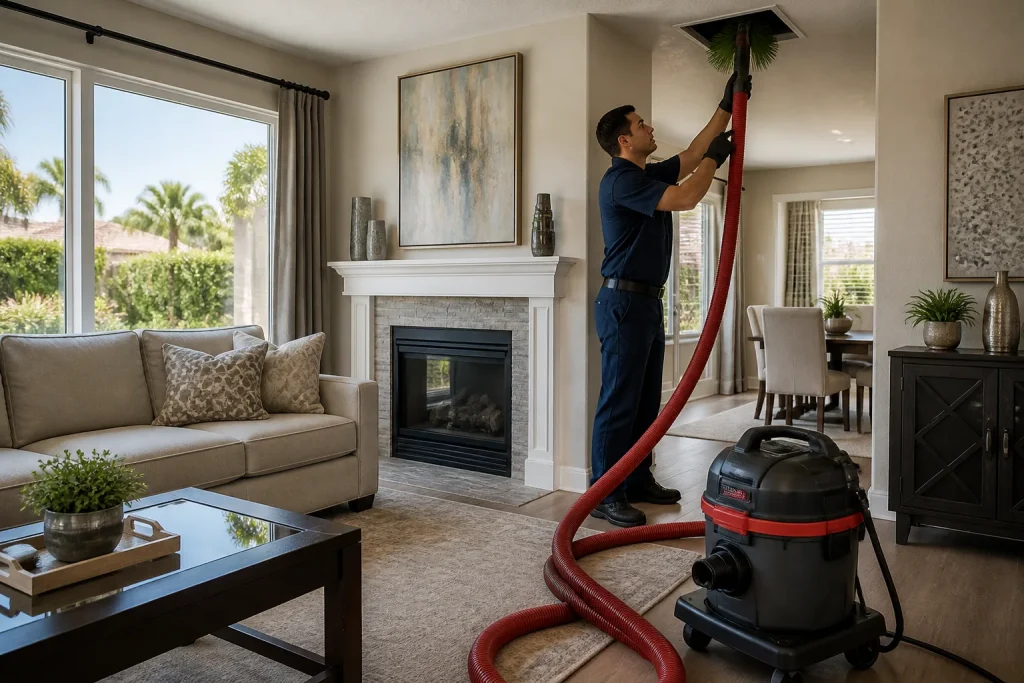
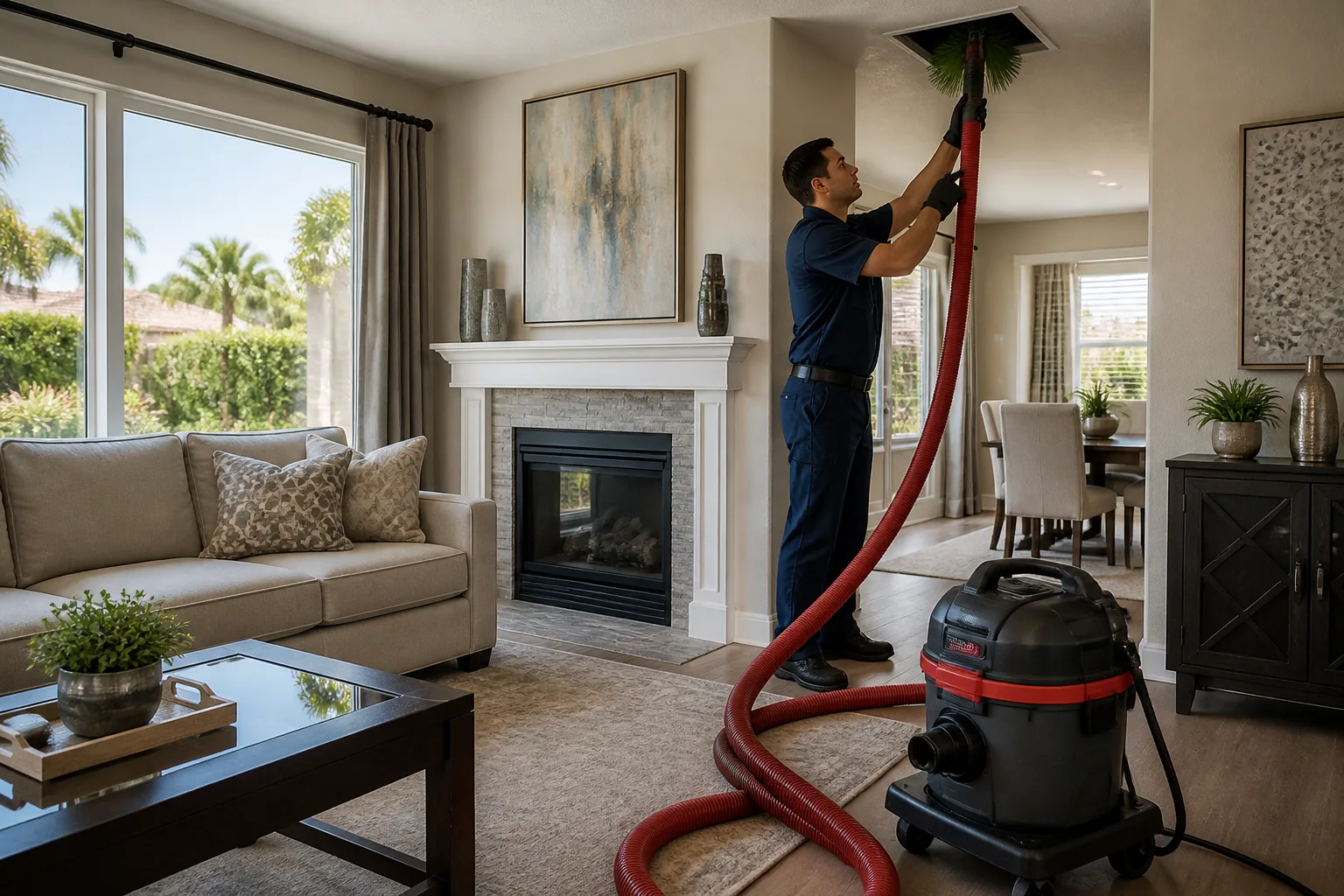
When we respond to a contamination call in Carlsbad, the Rotobrush system handles the mechanical agitation, while Nikro commercial HEPA vacuums capture what gets dislodged. For elevated contamination scenarios, we bring Abatement Technologies air filtration units to scrub the ambient air in the affected rooms while the duct work is being addressed. That is the operational difference between a cleaning and an actual emergency response.
This is also why “same-day service” is not the right first question. The right first question is: “What equipment is on the truck today, and can it capture what is in my ducts?” A company that answers “shop vac and brushes” is not equipped for an emergency. A company that answers with specific HEPA equipment and negative-pressure protocol is.
Questions to Ask Any Company Under Emergency Conditions
You are not in a position to comparison shop during a duct emergency, but you can vet a company in about ninety seconds on the phone. Here is what we recommend asking, in this order:
- “Can you confirm negative-pressure HEPA equipment is available on the truck today?” This is the single most important question. It filters out companies that do routine cleaning and call it emergency work.
- “Do you do post-cleaning air quality verification?” Without some form of before-and-after measurement, there is no way to confirm the contamination was actually removed. We are not talking about lab-grade certification on every job, but a company that cannot describe how they verify results is a risk.
- “Are you equipped for sanitation beyond mechanical cleaning?” Brushes and vacuums remove debris. They do not sanitize surfaces. If the emergency involves biological contamination, the company needs to be able to apply an EPA-registered antimicrobial to the duct surfaces after cleaning.
- “Do you perform air duct repair, or just cleaning?” A duct that is leaking is a duct that will re-contaminate within weeks. If the emergency involved smoke or sewage, there is a good chance the duct integrity was compromised. A company that only cleans will miss the real problem.
These four questions tell you whether you are hiring an emergency responder or a routine maintenance crew. In our experience, the companies that fail these questions are the ones that give the entire industry a bait-and-switch reputation.
Insurance Documentation: What to Photograph, What Not to Clean
If the emergency was caused by a covered event, a kitchen fire, a sewage backup, a flood, the duct cleaning may be part of a larger restoration claim. Handling the documentation correctly at the start protects you from having the claim denied later.
Photograph the source of the problem first. If it was a sewage backup, photograph the water line on the wall, the floor, and the air handler cabinet before anyone moves or cleans anything. If it was a fire, photograph the smoke staining around the return grilles and the visible soot inside the duct openings.
Do not clean or wipe anything visible before the adjuster visits. This is counterintuitive, because the instinct is to start cleaning immediately. But the adjuster needs to see the original condition to authorize the full scope of work, including duct cleaning and sanitization. If you wipe down the air handler and scrub the visible soot, the adjuster sees a smaller problem than what actually occurred.
Document the HVAC system status. Note whether the system was running when the event occurred, and for how long. That matters because it establishes how far the contamination may have traveled through the duct network. A system that ran for six hours after a fire moved smoke particles into every branch line. A system that was already off only has what settled naturally.
Get the duct cleaning scope in writing before work starts. Many restoration contractors include duct cleaning as a line item, but the actual scope varies wildly. Ask for a written description of the cleaning method, the equipment being used, and whether sanitization is included. That description becomes your leverage if the work does not match the claim.
One more note on this: duct cleaning that follows a covered event often qualifies as a restoration expense rather than routine maintenance. That distinction matters for your deductible and coverage. Document the cause-and-effect clearly, and do not let anyone describe the work as “routine cleaning” in the paperwork if it was event-driven.
When to Call a Pro Instead of Waiting
There is a time to research and a time to act. If you have any of the following situations in your Carlsbad home, do not wait to see how it “plays out”:
- You smell decomposition or sewage and cannot locate the source. That smell is moving through the duct system one way or another. The longer the fan runs, the worse it gets.
- A family member with asthma or allergies starts having unexplained symptoms. Duct contamination can exacerbate respiratory conditions within hours, not days. This is not a scare tactic; it is the reason emergency response exists.
- Visible mold is present on or around supply registers. That means the contamination is already at the point where it enters the living space. Every minute the system runs, spores are being distributed.
- You had a fire, flood, or sewage event, even a small one, and the HVAC system was running. The ductwork is now part of the contamination zone. It needs to be addressed as part of the restoration, not as an afterthought.
If you are in one of these situations, call (855) 353-1322. We answer 24/7. Fast dispatch from 7am to 7pm, Sunday through Friday. Tell us what happened, what you see, and what you smell. We can tell you over the phone whether this is something that needs immediate equipment on site, or something that can be booked into the next opening.
Related services in Carlsbad: dryer vent cleaning is a distinct fire-prevention service we handle with the same specialist team, and it is worth addressing when you are already evaluating your home’s airflow systems.
The Bottom Line
An emergency air duct situation in Carlsbad comes down to four things: shut the system down, identify the contamination type, ask whether the company has HEPA extraction equipment on the truck today, and document everything for insurance if a covered event caused it. Most homeowners skip at least one of these steps, and it costs them in either health or money. The companies that advertise “emergency duct cleaning” but show up with consumer-grade equipment are not equipped for what the word “emergency” actually means. Your ducts are only as clean as the equipment clearing them.
If you are in Carlsbad and need help, Duct Cleaning Carlsbad offers free estimates. Call (855) 353-1322. We answer 24/7. Fast dispatch from 7am to 7pm, Sunday through Friday.
Frequently Asked Questions
Same-day dispatch is possible when HEPA extraction equipment is available on the truck, which is why the equipment question matters more than the speed question. We answer 24/7 and dispatch from 7am to 7pm, Sunday through Friday. Call (855) 353-1322 and describe what happened. We will tell you honestly whether it needs immediate equipment on site or can be booked into the next opening.
No. Running the system after a contamination event spreads particulates through every branch of the duct network and into every room served by a supply register. The fan is a distribution device. Shut it off at the thermostat and the breaker, then call a professional. This is the single most common mistake that turns a contained problem into a whole-house one.
Every scope is different, which is why we set the price per job by written estimate after we see the contamination type and the size of the duct system. The estimate is free. A biological contamination event costs more than a particulate event because it requires sanitization after mechanical cleaning. Call (855) 353-1322 and we will talk through what you are dealing with before we give you a number.
It depends on the cause. If the contamination resulted from a covered event, such as a fire, flood, or sewage backup, the duct cleaning is often included as part of the restoration scope. Document the source of the problem with photos before cleaning, and do not touch visible contamination before the adjuster visits. Ask the company to provide a written description of the cleaning method and equipment, because that documentation matters when the claim is reviewed.
Written by the team at Duct Cleaning Carlsbad, serving Carlsbad since 2014.
Need Air Duct Cleaning Help?
Call Duct Cleaning Carlsbad - licensed & insured, here with fast help in Carlsbad.
(855) 353-1322